Execution Without Strategy
The U.S. military knows how to fight the war with Iran. It does not know how the war ends.

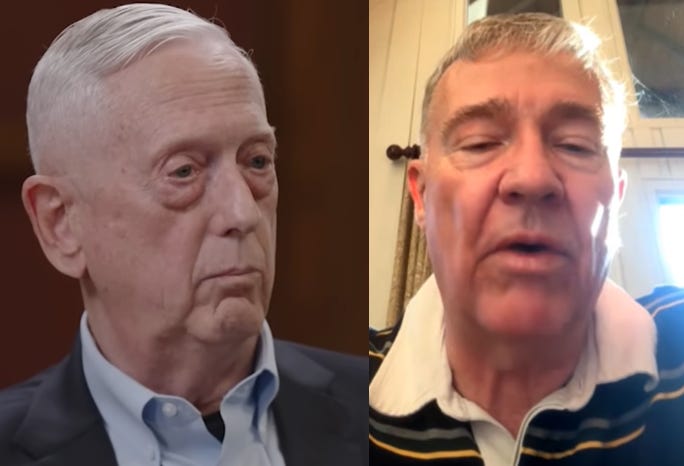
Former Secretary James Mattis and General Frank McKenzie from recent interviews (stills from PBS Firing Line with Margaret Hoover and U.S. Naval Institute podcast via YouTube)
Senior military leaders operate primarily at the operational level, defer to civilian leadership on strategy, and are institutionally disincentivized from questioning whether the war itself is coherent or winnable.
This is a different sort of post. It offers insights into the thinking of senior military officers leading the war on Iran by examining the candid insights and perspectives of two former Commanders of United States Central Command (CENTCOM) who talk about the ongoing war in Iran in recent interviews. These two interviews reveal not just how the war is being fought—but how the U.S. military thinks about war when strategy is unclear.
Current military leaders are very likely approaching the war with similar mindsets and perspectives. They are primarily oriented toward the operational level of war, at the expense of the strategic/policy levels of the conflict in deference to the orders they’ve received from the political leadership.
In a previous article, I talked about the disincentives and institutional barriers that dissuade serving military leaders to speak out about their reservations during war even when they may believe the war’s justification is suspect or goals of the war are not achievable through military means. Retired officers are not subject to the same constraints, and we often hear from them in the media providing context and commentary on military operations. What they say and don’t say speaks volumes about the role of the military and its limitations.
Former Defense Secretary James Mattis and General Frank McKenzie both served as commanders of CENTCOM and were responsible for drafting the concept plans and operational plans for a variety of conflict scenarios in the region, including limited strikes or war against Iran. They have each thought through and tried to solve the military challenges that fighting against Iran would entail. The ongoing operations against Iran reflect the kinds of plans and frameworks these leaders helped develop. They both have deep knowledge of the Gulf region and built the deep partnerships that now permit us to conduct combat operations.
You may hear talk in the media of “war plans.” It is a term that holds little meaning inside the Defense Department. There are two types of plans that guide thinking and action in the Pentagon: Concept Plans (or a CONPLAN), and Operations Plans (or an OPLAN). A CONPLAN provides a strategic concept and broad operational approach along with major force requirements described at a high level. An OPLAN is a fully developed, executable plan that identifies specific units, provides detailed phasing, describes necessary logistics and sustainment, identifies communications architecture, and establishes command relationships. An OPLAN can be readily executed on order of the president. This distinction matters because it explains how the military can be ready to fight without answering whether the war makes sense.
Secretary Mattis and General McKenzie, both Marines, share many similarities in background and experience. Even so, they each offer very different perspectives on the ongoing war against Iran. Both are (as are many of their peers) what I would characterize as conservative in their outlook. Secretary Mattis served as Trump’s first Secretary of Defense. I have encountered both of them at different stages of my career and have abiding respect for them, not only as professionals, but as decent human beings dedicated to a life of service.
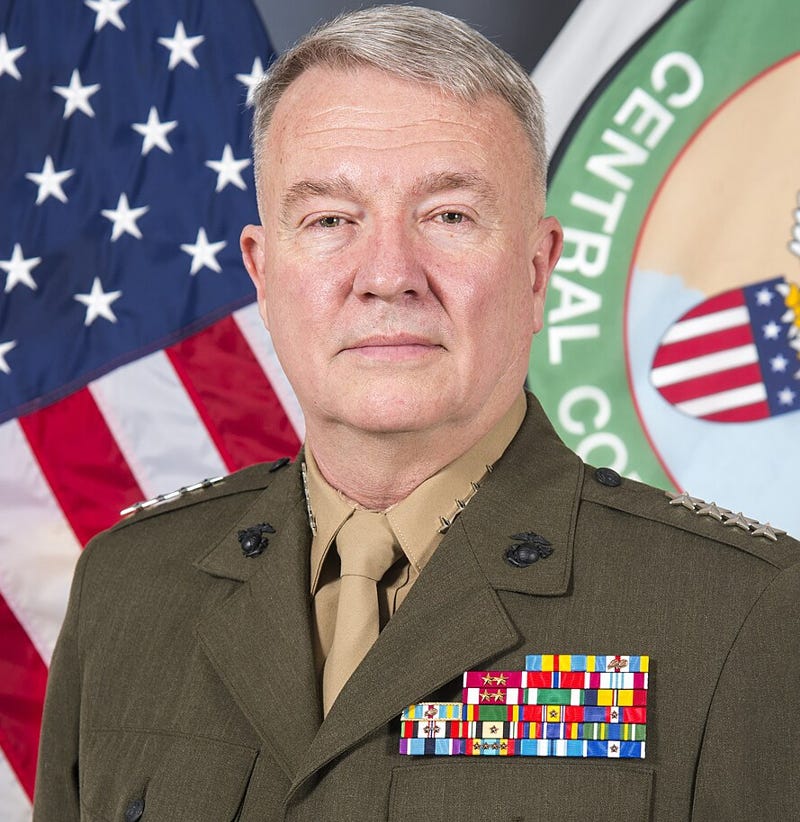
General Frank McKenzie (Wikipedia)
General McKenzie was interviewed by defense experts at the U.S. Naval Institute and the discussion centered on tactical and operational aspects of the war in Iraq. The U.S. Naval Institute is what I would characterize as an unofficial intellectual incubator for the Navy and Marine Corps. Their podcast audience would generally gravitate towards serving and retired military, academics, and defense experts in government and industry.
It is not surprising that General McKenzie would focus on the execution of the OPLAN he helped author and the defense architecture and relationships he helped to put in place. He is quite satisfied with the performance of the Joint Force (the mix of forces from the Army, Air Force, Navy, Marines, and Guardians) operating across air, sea, land, space, and cyberspace. He expresses clear confidence as he describes the performance and successes of CENTCOM forces and his pride in both the plans and their execution is evident as he describes them. This does not diminish the seriousness with which he confronts the challenges still facing CENTCOM as he reminds the listeners that “the enemy gets a vote.”
He describes the plans as a campaign that will take time and be adjusted as political objectives and goals emerge. General McKenzie makes clear that the campaign is in service to the political goals and objectives of the commander in chief and will be adjusted as the situation on the ground evolves. He anticipates that the war will hinge on resolution of three objectives: free passage through the Strait of Hormuz, some agreement on nuclear materials and weapons, and some restriction on ballistic missiles. He doesn’t speculate as to contours of those agreements.
General McKenzie addresses the closure of the Strait of Hormuz as a Joint Force problem, meaning that he is solving the challenge of Iranian closure as a military problem to be solved with the right combination of forces and tactics. CENTCOM has planned for this kind of operation and has conducted operations in the past to ensure freedom of navigation in the Gulf and around the world. It would be difficult, he admits, but it can be done. What is revealing is that he treats closure of the Strait as a military problem to be solved, not a political problem to be avoided.
The war is having a devastating impact on the people of Iran. Well over 3 million people have been internally displaced, many have been killed and wounded as collateral damage from American and Israeli strikes, and water and food shortages could lead to starvation and disease. When asked about the military responsibility for the civilians impacted by the war, General McKenzie states that military is not getting into that lane. This reflects not indifference, but a clear institutional boundary: the military finds it uncomfortable to integrate humanitarian consequences into operational decision-making. The administration has also dismantled recent efforts to do so in the Pentagon. There are no apparent efforts elsewhere in the government to alleviate the conditions created by the war on Iranian civilians.
General McKenzie’s interviewers are both retired Navy officers. It is notable to me the degree of deference they give to General McKenzie and that they did not press him or challenge him on his answers. This is typical of the culture within the military and the deference both to the hierarchy and the reverence shown to general officers and flag officers. This can be problematic when senior leaders’ assumptions and views are not challenged.
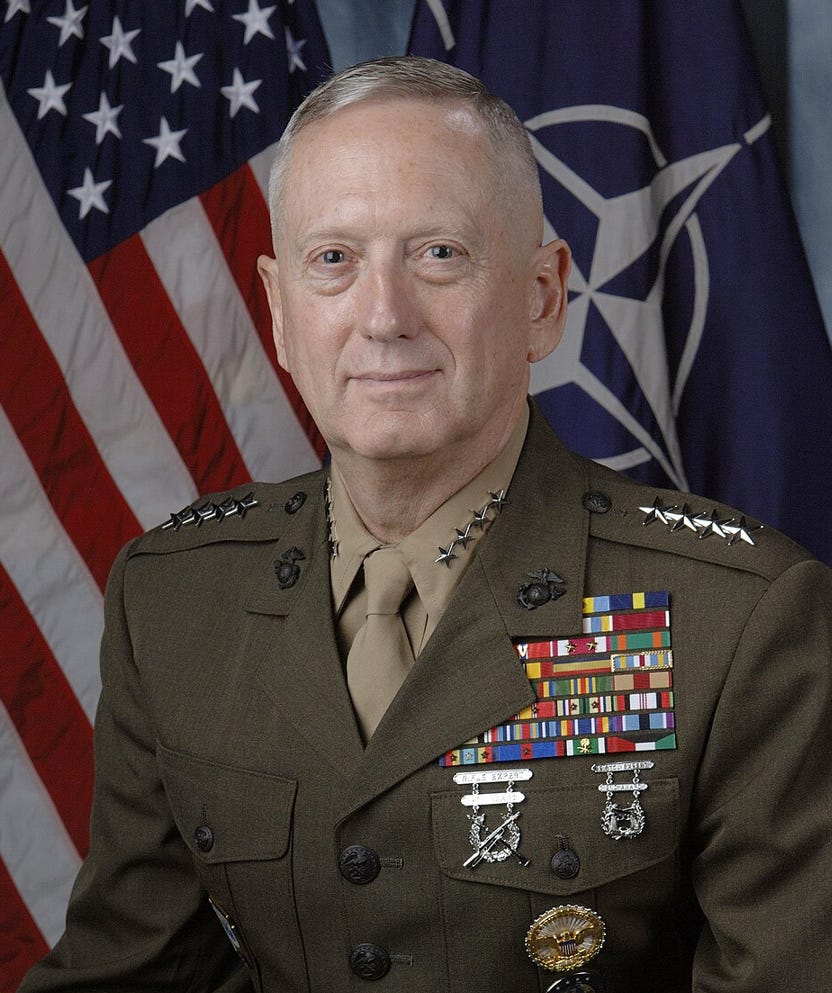
Secretary James Mattis (Wikipedia)
Secretary James Mattis retired as a Marine General and served as Trump’s first Secretary of Defense. I’ve encountered Secretary Mattis through my entire Pentagon career and consider him to be a military officer of exceptionally rare talent: an officer brilliant at the tactical, operational, and strategic levels of war. This is far less common than you might imagine. Secretary Mattis and Secretary George Marshall (of the Marshall Plan) stand out as two secretaries who have exceptional records across all three levels.
The integration of the strategic dimension in Secretary Mattis’ commentary is what stands out to me in contrast to General McKenzie, to whom strategy and the role of the political leadership is almost an afterthought. He points out that Iran’s regime is engaged in “total war,” while we are engaged in a limited war. The strategic implications are immediately obvious—the United States will seek to limit the effects of the war while it is to Iran’s strategic advantage to spread and multiply the impact of the war.
Secretary Mattis expresses a view that is shared among many in the professional military class: that we have been at war with Iran and that Trump’s war is a continuation of a conflict being conducted by Iran’s proxies against the United States and others since the bombing of the Marine barracks in Beirut, Lebanon, that killed 241 U.S. servicemembers in 1983. In this view, there is no requirement for a war declaration and no question as to the legitimacy of military action against the Iranian regime.
Secretary Mattis addresses the challenge of regime change head on. He identifies the number one indicator of a repressive regime being able to stay in power: a willingness to kill its citizens on an industrial scale in order to stay in power. It is apparent that the regime meets this criteria as they had killed thousands of protesters in the unrest preceding the war and Secretary Mattis does not believe that the regime is ready to break now.
Secretary Mattis, when asked about the purpose of the war or its desired end state, says that it is murky. He describes what the military calls, the commander’s intent. The commander’s intent is a core concept in U.S. military doctrine that describes the “why” or purpose, what must be done, and the desired end state. This is applied to any mission regardless of the size, scale, or scope of the mission. Secretary Mattis admits that the commander’s intent for this war is simply not evident because of the confusing and contradictory messaging coming from Trump and the administration.
Without allies, Secretary Mattis admits that we cannot succeed in this war. America is becoming predatory and unreliable and we are no longer a reliable security partner. Our allies, other than Israel, are not coming to our aid in this war. Our actions to punish allies with tariffs and our economic leverage represent a strategic disconnect for Secretary Mattis. General McKenzie admits that we would benefit from participation by our allies, but asserts that we can go it alone against Iran.
The most remarkable and poignant statement Secretary Mattis made during the interview was that “a good strategy is an appetite suppressant to war.” Lacking a clear strategy, Trump has rushed to war without fully considering the full consequences. General McKenzie remarked in his interview that Trump was the first president of either party to stand up and defend against Iran, something he clearly admires. He further argues that this provides the United States an advantage in negotiations with Iran. The counter argument to General McKenzie’s position (and one that would likely be supported by Secretary Mattis) is that Trump and the administration did not fully consider the consequences of going to war—particularly the second and third-order effects that we currently see compounding beyond the military domain.
I believe it is important to note that both Secretary Mattis and General McKenzie have supported Trump publicly though both have also been critical of some of his decisions. Secretary Mattis resigned as secretary implicitly criticizing Trump’s decisions with respect to allies and partners. Both were professional military leaders who understood the role the political leadership expected them to play and drew from their vast experience and significant operational talents to position the United States to effectively conduct military operations in the Gulf, should the department be directed to do so.
General McKenzie expresses operational confidence and the ability of the U.S. military to execute the war. Secretary Mattis addresses strategic ambiguity and the importance of alliances and partnerships. General McKenzie shows how the system executes. Secretary Mattis reveals the limits of the strategy guiding that execution. The system is designed to produce executable plans—not to ensure those plans achieve coherent political outcomes. It answers the question “How do we fight?” with precision—but leaves “Why are we fighting?” unresolved.
That we have such similarly talented leaders now leading operations in the ongoing war with Iran should not give us confidence that they will lead us to victory.
The military can execute brilliantly. But execution is not strategy—and it cannot compensate for its absence.
General Frank McKenzie interview link
Secretary James Mattis interview link
a